Find your bearings
A calm resort coast. A wild windward interior.
Aruba runs northwest to southeast, with most resorts and swimmable beaches along the protected western shore. Arikok, the caves and the rough Atlantic coast occupy the east; San Nicolas and Baby Beach anchor the quieter south.
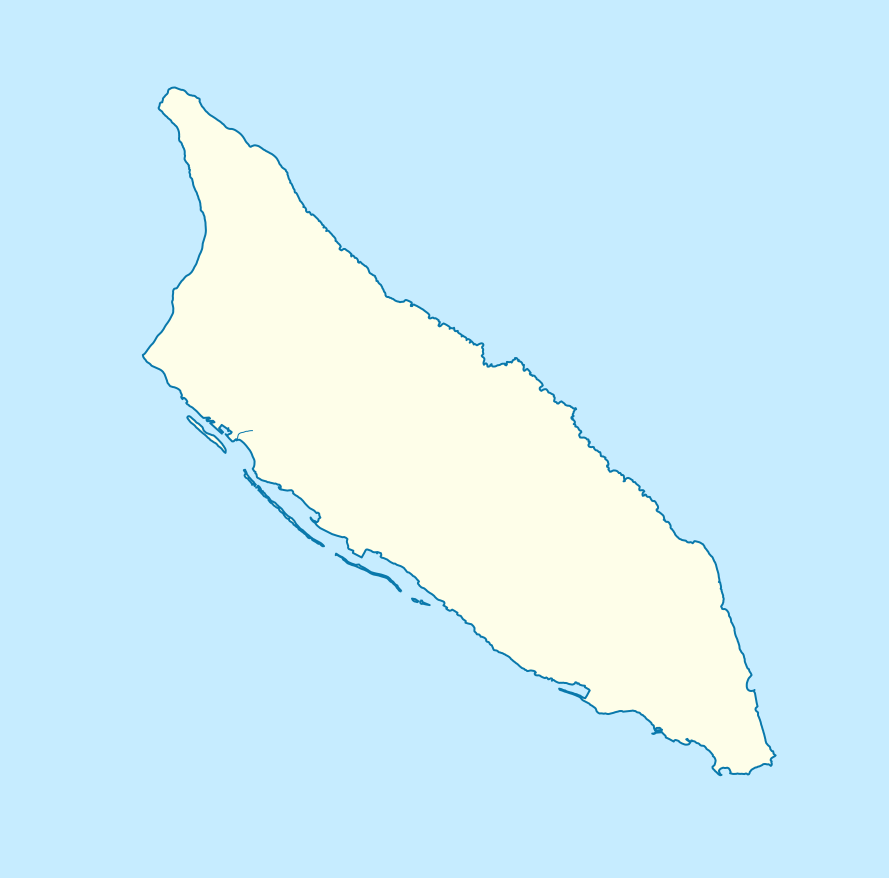 Caribbean SeaAtlantic OceanCalifornia LighthouseDunes & north-coast viewsPalm BeachHigh-rise resortsEagle BeachLow-rise coastOranjestadCapitalAUA AirportInternational gatewayArikokNational parkSan NicolasMurals & local cultureBaby BeachSheltered lagoon
Resorts, dining, watersports and the island’s calmest vacation infrastructure.
Caves, desert trails, natural landmarks and rough open-ocean conditions.
Local restaurants, murals, snorkeling coves and a slower independent base.
Know Aruba
Caribbean blue. Desert gold.
Aruba is the smallest of the Dutch ABC islands, set about 15 miles north of Venezuela. Its calm leeward coast carries the famous white beaches; the interior and windward side reveal cacti, limestone terraces, caves, crashing surf and a landscape unlike the lush volcanic Caribbean.
A brief history
Caquetío people from the Arawak cultural world settled Aruba long before Europeans. Spain claimed the island after Alonso de Ojeda’s 1499 voyage; the Dutch West India Company took control in 1636. Gold, aloe and later the Lago oil refinery each reshaped Aruba’s economy and its remarkably multicultural population.
On January 1, 1986, Aruba achieved Status Aparte, leaving the Netherlands Antilles to become a self-governing country within the Kingdom of the Netherlands. The Kingdom remains responsible for defense and foreign affairs.
What it is most known for
Dependable sunshine, trade winds, Eagle and Palm beaches, wreck diving, welcoming multilingual culture and a well-developed, easy vacation infrastructure. Aruba works especially well for travelers who want beautiful water without giving up dining, nightlife, direct flights or independent exploration.
Geography
Roughly 20 miles long and six miles wide, Aruba is dry, breezy and mostly flat, with Jamanota rising to about 620 feet. The west and south coasts are generally calmer; the northeast is rugged, wave-battered and often unsafe for swimming.
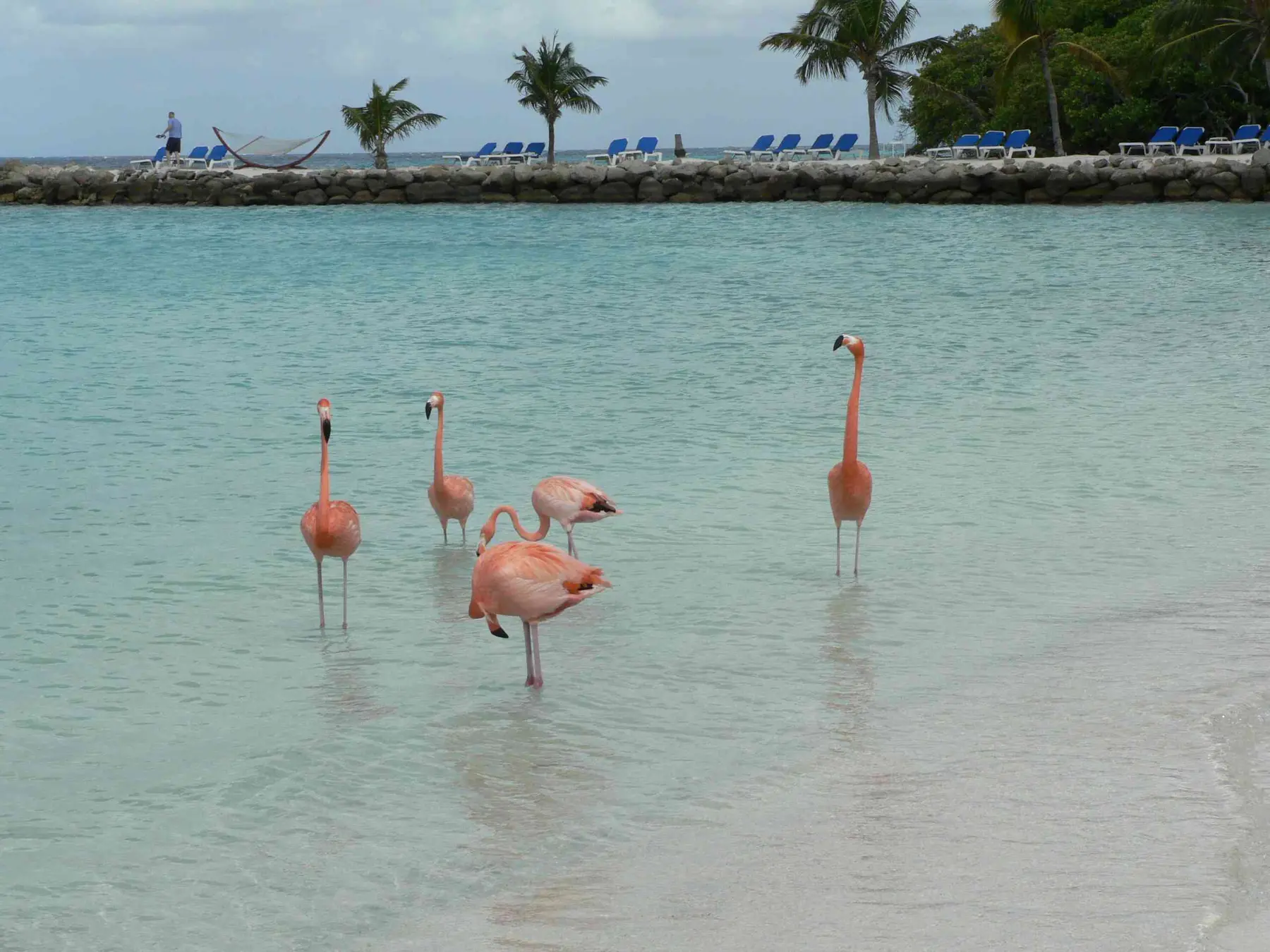
The flamingos visitors associate with Aruba live on privately operated Renaissance Island. Access is generally reserved for resort guests or limited day-pass holders, so confirm availability before building a day around the experience.
David Stanley · Wikimedia Commons · CC BY 2.0Plan your trip
Sunny almost always. Distinctly yours by season.
December–April
The driest, breeziest months and the most dependable beach weather—along with peak crowds and rates.
May–August
Still sunny, usually windier and often better priced. A strong window for wind sports and families.
September–November
Hotter, less windy and somewhat rainier, with fewer visitors and attractive hotel offers.
Is Aruba hurricane-safe?
Aruba sits outside the main Atlantic hurricane belt and direct strikes are rare, making it one of the Caribbean’s lower-risk choices during the June 1–November 30 season. It is not risk-free: nearby storms can still bring heavy rain, rough seas, flight disruption and unusual heat when the trade winds drop. Keep flexible plans and storm coverage for late-summer or autumn travel.
Arrivals
How to get to Aruba.
Aruba is one of the Caribbean’s easier islands to reach, with a large international airport and frequent service from North America. Unlike several northern island groups, arriving here rarely requires a ferry or puddle-jumper connection.
Fly into Queen Beatrix International
Queen Beatrix International Airport (AUA) receives nonstop flights from many U.S. and Canadian cities, the Netherlands, Latin America and Caribbean hubs. The airport is close to Oranjestad: roughly 10 minutes by taxi, 15–20 minutes to Eagle Beach and about 20–30 minutes to Palm Beach depending on traffic.
Aruba has U.S. preclearance, so departing passengers complete U.S. immigration and customs before boarding. Follow your airline’s early-arrival guidance, especially on busy weekends and holidays.
Choose your rhythm
Where to stay in Aruba
Aruba is compact, but your base changes the trip. Palm Beach is effortless and social; Eagle Beach is calmer and more elegant; Oranjestad adds culture; the south trades resort convenience for local character and open space.
Best for first-timers, families & nightlife
Palm Beach & Noord
The easiest resort base: calm water, high-rise hotels, watersports, shopping, casinos and a deep restaurant bench. It is convenient and energetic, but the beach is busier and the setting feels less intimate.
- Nearby
- Palm Beach, Hadicurari, Malmok, Boca Catalina & Arashi
- Consider
- The St. Regis, Ritz-Carlton, Marriott Stellaris, Hyatt Regency, Hilton, Boardwalk Boutique
Best for calm, couples & wide-open sand
Eagle Beach & Manchebo
Low-rise hotels, a slower rhythm and Aruba’s most beautiful uninterrupted beachscape. You are still close to Oranjestad and Palm Beach, though there is less nightlife directly outside the door.
- Nearby
- Eagle Beach, Manchebo Beach & Druif Beach
- Consider
- Bucuti & Tara, Manchebo Beach Resort, Amsterdam Manor, JOIA Aruba, MVC Eagle Beach
Best for color, culture & short stays
Oranjestad
Choose the capital for pastel Dutch-Caribbean architecture, museums, shopping and easy access to the airport. Cruise-ship days can feel busy, and the signature resort beaches require a short bus or taxi ride.
- Nearby
- Surfside Beach, Renaissance Island by guest access & Druif nearby
- Consider
- Renaissance Wind Creek, Talk of the Town, Victoria City Hotel and downtown apartments
Best for local flavor, diving & seclusion
Savaneta & the South
A quieter, more residential coast near Mangel Halto, San Nicolas and Baby Beach. It rewards independent travelers and repeat visitors, but a rental car is important and resort-style dining is sparse.
- Nearby
- Mangel Halto, Rodgers Beach & Baby Beach
- Consider
- Aruba Ocean Villas, Serene by the Sea, Secrets Baby Beach and independent villas
More than 20 public beaches & coves
The beaches worth building a day around.
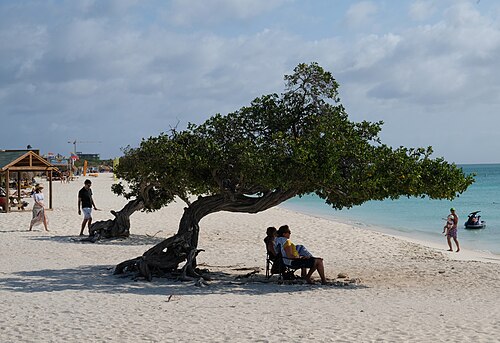
Eagle Beach
Aruba’s broad, luminous showpiece: soft white sand, calm blue water, room to breathe and the island’s famous fofoti trees.
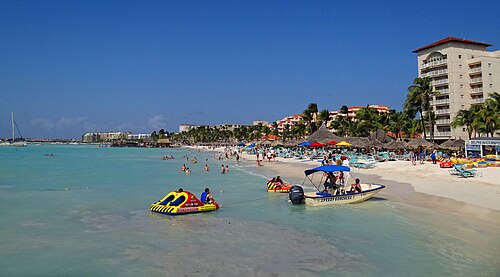
Palm Beach
Two lively miles of high-rise resorts, piers, restaurants and watersports. Come for convenience and energy.
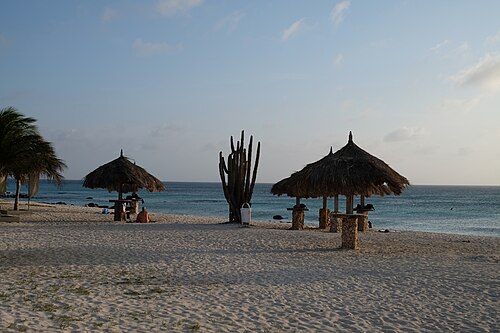
Arashi Beach
A relaxed north-coast favorite with palapas, a beach bar and easy swimming; the rocky edges can offer snorkeling in calm seas.
Boca Catalina & Tres Trapi
Small coves with clear entry points for snorkeling. Arrive early, watch boat traffic and never chase or touch turtles.
Baby Beach
A photogenic half-moon lagoon with shallow water. Stay inside the protected bay—the channel at the opening can have strong current.
Mangel Halto
Mangroves, blue water and excellent shore snorkeling for confident swimmers. The outer reef and drop-off are for experienced divers.
Manchebo Beach
Wide, quiet and romantic at Aruba’s western point, with fewer crowds and stronger water movement than neighboring Eagle Beach.
Boca Grandi
Wild, windswept and beautiful—one of Aruba’s great kitesurfing scenes, not a casual swimming beach.
Mild–moderate regional outlook
Checked July 26, 2026
Regional monitoring shows an active 2026 Caribbean season, while the July subregional outlook calls for mild-to-moderate conditions. Aruba’s windward east and southeast coasts take the greatest exposure; Boca Grandi and other open coves can collect seaweed. The protected west-coast resort beaches—including Eagle, Palm, Manchebo and much of Malmok—are usually more reliable fallbacks, though no beach is guaranteed clear on a particular day.
The experiences people book first
Aruba’s most popular tours.
The strongest outings show why Aruba is more than a resort strip: wrecks beneath the west coast, cactus country inland, and creative communities in the south.
Arikok & Natural Pool
Cross cactus country to caves, rugged coast and Conchi with a park-aware guide. Swimming at the natural pool depends on sea conditions, not the tour brochure.
Antilla wreck snorkel sail
Sail the protected west coast to Aruba’s signature wreck, usually with a second reef or beach stop. A smaller boat feels calmer; larger vessels lean social.
North-coast island tour
Link California Lighthouse, Alto Vista Chapel, Bushiribana and the wave-battered coast by jeep, UTV or private vehicle, with access chosen for current road conditions.
San Nicolas & Baby Beach
Pair the island’s mural district and a local lunch with Baby Beach or Rodgers Beach. A guide adds context that a straight hotel-to-lagoon transfer misses.
Spanish Lagoon paddle
Explore the island’s mangrove and seagrass habitat by kayak or clear-bottom boat, then continue to Mangel Halto or a waterfront meal in Savaneta.
Sunset sail
Cruise the leeward coast as the wind softens and the resort lights come on. Compare passenger count, music level and whether the boat genuinely sails before booking.
On & under the water
Wrecks, reefs, sails and wind.
Deep-sea fishing
Aruba is one of the easiest islands on which to book deep-sea fishing. Boats leave Oranjestad, Renaissance Marina and Hadicurari near Palm Beach, reaching deep water quickly for mahi-mahi, wahoo, tuna, kingfish, barracuda, sailfish and occasional blue or white marlin.
Best timing: Trips operate year-round. Wahoo and billfish have seasonal peaks, but trade winds can make the sea lively in any month; a larger sport-fishing boat is worth considering for motion-sensitive guests.
Scuba & snorkeling
Aruba is best known for accessible wreck diving, especially the 400-foot Antilla and the scattered remains of the Pedernales. Reefs, seagrass and mangroves within Parke Marino Aruba support turtles, rays, morays, octopus, barracuda and tropical fish. Coral condition varies: choose a conservation-minded operator and never stand on coral, feed wildlife or touch sea turtles.
- Signature wrecks: Antilla, Pedernales, Jane Sea and Star Gerren; depth, current and certification requirements vary.
- Reef dives: Mangel Halto, Arashi Reef, Harbor Reef and Barcadera.
- Snorkel: Boca Catalina, Tres Trapi, Arashi and Mangel Halto on calm mornings.
- Safety: stay inside Baby Beach’s lagoon and avoid the rough northeast coast; currents and boat traffic are real hazards.
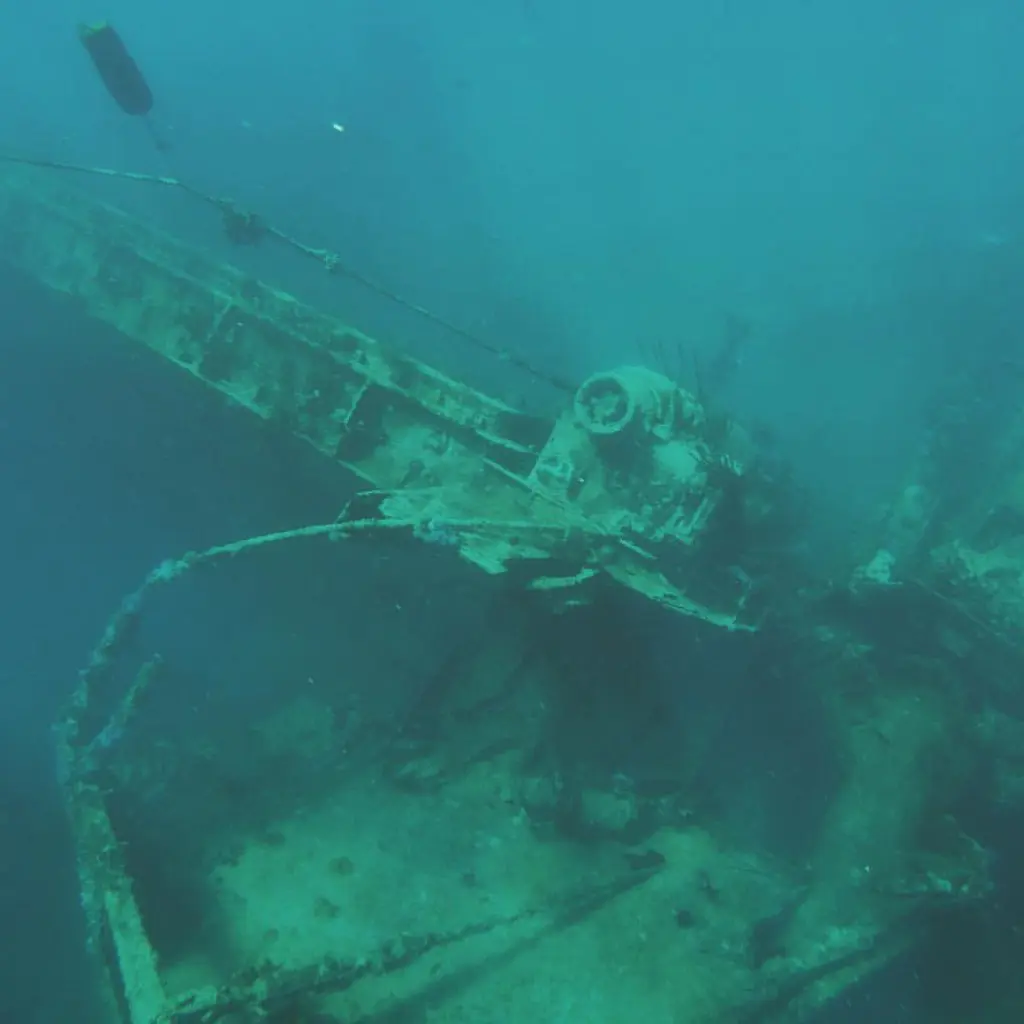
The Antilla is Aruba’s signature wreck, but the surrounding marine life is just as memorable. Conditions vary with wind and current, so divers and snorkelers should use a reputable operator and give turtles generous space.
Charlie (ceonyc) · Flickr · CC BY-SA 2.0Sailing
Aruba’s leeward west coast offers steady trades, open sunset water and popular catamaran stops near Malmok and the Antilla. Cruising yachts have fewer protected overnight options than in the Grenadines or Virgin Islands, so plan Aruba as a formal port stop.
- Check in/out: follow Aruba Ports Authority instructions at Oranjestad; everyone stays aboard until Customs and Immigration clearance is complete.
- Anchorages: use designated areas and confirm current marine-park restrictions. The windward coast is exposed and unsuitable for casual anchoring.
- Marinas: Renaissance Marina and Varadero Aruba can assist with berths, services and local procedure; reserve ahead.
- Provisioning: Super Food Plaza, Ling & Sons and major Noord-area markets are practical by taxi or rental car.
Surfing & wind sports
Aruba is far more dependable for windsurfing and kitesurfing than for board surfing. Fisherman’s Huts at Hadicurari is the classic flat-water learning and windsurf scene; Boca Grandi offers strong onshore wind for experienced kiters. Wave surfers look to Andicuri, Wariruri and Dos Playa when swell cooperates, but reefs, currents, isolation and inconsistent conditions make local guidance essential.
Culture & land
Beyond the hotel strip.
Culture
Aruba’s identity blends Caquetío roots, Dutch Caribbean history and more than 90 nationalities. Papiamento is the intimate language of daily life; Carnival fills early-year streets with brass, tumba and color. Visit the National Archaeological Museum, Fort Zoutman, the Aruba Aloe Museum and San Nicolas’s murals. Flag and Anthem Day is March 18; Dera Gai is celebrated June 24.
Hiking
Arikok National Park protects nearly one-fifth of Aruba, with cactus country, lava and limestone formations, Fontein and Quadirikiri caves, Jamanota and rugged coast trails. Hooiberg’s stair climb gives a quick panorama; Ayo and Casibari offer gentler boulder walks. Start early, carry more water than expected and use a ranger or guide for remote routes. Conchi access is rough and sea entry can be dangerous.
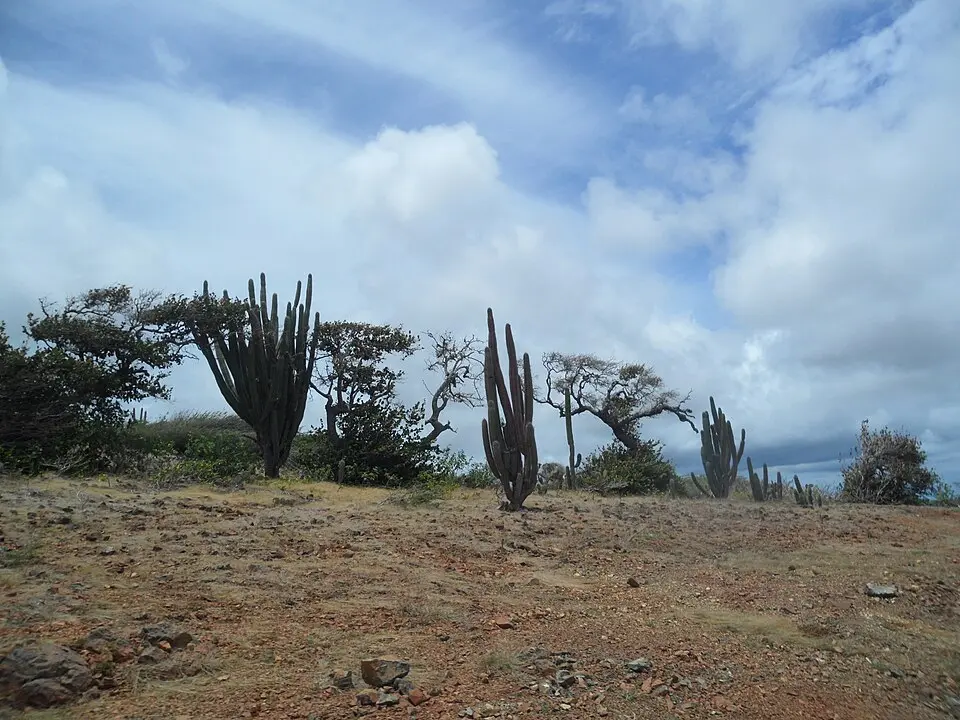
Arikok replaces palms with cactus scrub, volcanic rock and limestone caves. Go early, carry serious water and let the landscape set the pace.
EgorovaSvetlana · Wikimedia Commons · CC BY-SA 4.0The annual calendar
Aruba Carnival—the island’s essential annual celebration.
Carnival is the one Aruba event we would actively use to shape a first-time visitor’s trip. The season typically runs through January and February, culminating before Ash Wednesday; confirm that year’s parade calendar before booking.
January–February · Island-wide
Aruba Carnival
Weeks of music, jump-ups, costumes and parades build toward the Grand Carnival Parade in Oranjestad and the season’s final celebrations.Eat & sleep well
Dutch Caribbean, Latin and deeply local.
Look beyond the resort strip for keshi yena, cabrito stoba, fresh catch, funchi, pan bati and pastechi. Aruba also has an ambitious international dining scene. Reserve tasting menus and sunset tables well ahead in high season.
Papiamento, Wilhelmina, Senses Fine Dining, Quinta del Carmen or Fred Royal
Lima Bistro, Yemanja Woodfired Grill, Azia, Ever Restaurant or Infini
Zeerovers, The Flying Fishbone, Barefoot or Pinchos
Pastechi House, Huchada, Kamini’s Kitchen, Local Store or a snack-truck stop in San Nicolas
Hotel shortlist
Serene & romantic
Bucuti & Tara for adults-only Eagle Beach calm; Boardwalk for lush boutique style near Palm Beach; Aruba Ocean Villas for an intimate southern escape.
Full-service luxury
The St. Regis and Ritz-Carlton for upscale Palm Beach stays; Hyatt Regency and Marriott Stellaris for broad amenities and easy beach access.
Families & easygoing stays
Hilton or Holiday Inn on Palm Beach; Amsterdam Manor, JOIA or MVC near Eagle Beach; Secrets Baby Beach for adults-only all-inclusive seclusion in the south.
Before you go
The practical details.
Both are official; English and Spanish are widely spoken.
U.S. dollars are widely accepted; posted business exchange rates vary slightly.
Cards are common. Carry small cash for buses, tips, markets and beach vendors.
U.S. plugs usually work; a universal adapter covers occasional European-style sockets.
Desalinated tap water meets high quality standards; refill.
A valid foreign license is accepted; roundabout traffic has priority.
Transportation
Queen Beatrix International Airport sits minutes from Oranjestad. Arubus is an inexpensive choice between downtown and the hotel strip, and taxis use official zone-based fares. Rent a car for Arikok, Baby Beach, Savaneta and flexible restaurant nights. A normal car covers paved sights; use a suitable 4x4 or guided vehicle only where permitted on rough routes.
Safety
Aruba currently carries a U.S. Level 1 “exercise normal precautions” advisory. Lock vehicles, leave nothing visible, use licensed taxis and operators, and take extra care around isolated coastal areas after dark. The greatest visitor risks are often sun, dehydration, road incidents and rough water.
Health & vaccines
Keep routine vaccines current. CDC recommends hepatitis A and hepatitis B for unvaccinated travelers; other needs depend on age, itinerary and medical history. Prevent mosquito bites because dengue can occur. Yellow-fever vaccination is not recommended for Aruba itself, but proof may be required when arriving from certain risk countries. Discuss your itinerary with a clinician before travel.
Entry basics
Entry rules depend on nationality. U.S. travelers currently need a valid passport, an approved online embarkation and disembarkation card, and onward or return arrangements. Confirm the current requirements with Aruba and your airline.
Entry rules, prices, schedules, health advice, weather and sea conditions can change. Reconfirm details with official sources and your providers before booking or departing.
Research desk
Official sources & live checks
Entry forms, park access, marine conditions and sargassum can change quickly. Use these links for the final checks close to departure.