Know the island
The Caribbean’s wild side is very much awake.
Dominica—pronounced dom-in-EEK-a—is distinct from the Dominican Republic. This steep, volcanic and deeply green island is built for rainforest trails, waterfalls and active days. The sea is equally dramatic, with walls, geothermal vents and resident sperm-whale families.
A brief history
Indigenous Kalinago called the island Waitukubuli, often translated as “Tall is her body.” Their resistance and Dominica’s rugged terrain slowed European settlement. France and Britain contested the island; Britain gained control in 1763 and expanded plantation agriculture through enslaved African labor.
Slavery was abolished in 1834. Dominica became independent from Britain on November 3, 1978, as a parliamentary republic. Today it contains the Caribbean’s largest surviving Kalinago community, centered in the Kalinago Territory on the east coast.
What Dominica is most known for
Boiling Lake, 365 rivers, rainforest waterfalls, the Waitukubuli National Trail, canyoning, geothermal springs, Champagne Reef, the Kalinago Territory, endemic parrots and one of the world’s most remarkable year-round sperm-whale populations.
Geography
Dominica lies between Guadeloupe and Martinique. It is roughly 29 miles long, mountainous and geologically young, with nine potentially active volcanic centers. Morne Diablotins reaches 4,747 feet; deep water falls away close to the calmer west coast, creating prime habitat for cetaceans.
Plan your trip
Drier is relative on an island powered by rain.
February–May
The driest general window for hiking and diving, with warm water and fewer weather disruptions. Trails can still be muddy.
November–March
Resident sperm whales may be seen all year, but the calmer winter season is traditionally favored for boat excursions.
June–November
Wetter, hotter and inside hurricane season. Rivers rise quickly and trails, roads and ferries can be disrupted.
Is Dominica hurricane-safe?
No. Dominica lies in the Atlantic hurricane belt and suffered catastrophic damage from Hurricane Maria in 2017. June through November requires serious insurance, flexible bookings and attention to forecasts. Heavy rain also creates flash-flood, landslide and river-crossing risk even without a named storm.
Arrivals & island connections
How to get to Dominica.
Most visitors arrive at Douglas–Charles Airport (DOM) on the northeast coast. Nonstop service changes seasonally and may include Miami plus regional connections from Barbados, Antigua, San Juan, St. Maarten and neighboring islands. Canefield Airport near Roseau handles limited regional or charter traffic. Complete Dominica’s electronic immigration form before travel.
Douglas–Charles (DOM)
The airport is convenient to Marigot and Calibishie but roughly 75–120 minutes from Roseau, depending on weather, road conditions and traffic. Prearrange a transfer or rental-car handoff.
Martinique, Guadeloupe & Saint Lucia
FRS Express des Îles links Roseau with Fort-de-France, Pointe-à-Pitre and selected Saint Lucia services. Schedules vary by day and season; crossings and immigration take longer than the map suggests. Reconfirm before building separate flights around a ferry.
Choose your base
Where to stay in Dominica
A short distance can be a long drive here. Choose for the experiences outside your door, not the island’s geometric center. For seven nights or more, a south-and-north split is usually worth the unpacking.
Best for a first visit & major adventures
Roseau, Trafalgar & Wotten Waven
The capital and surrounding highlands place Boiling Lake, Titou Gorge, Trafalgar Falls, hot springs and the southern dive coast within reach. Roseau is practical; the hills above it feel greener and calmer.
- Nearby
- Morne Trois Pitons, Boiling Lake trailhead, whale boats, Champagne Reef
- Consider
- Fort Young Hotel, Cocoa Cottages, Ti Kwen Glo Cho-area guesthouses
Best for diving, snorkeling & quiet
Soufrière & Scott’s Head
Stay inside the island’s volcanic marine landscape for quick access to Champagne Reef, dramatic walls and Scott’s Head. The villages are small and peaceful, with limited nightlife and dining.
- Nearby
- Soufrière–Scott’s Head Marine Reserve, Champagne, Bubble Beach
- Consider
- Jungle Bay, Coulibri Ridge, Soufrière guesthouses and apartments
Best for sailing, beaches & the north
Portsmouth & Prince Rupert Bay
Dominica’s second town offers the Indian River, Cabrits, easy west-coast water and a useful base for northern hikes. It has more services than the remote north but less access to Roseau’s signature southern excursions.
- Nearby
- Indian River, Cabrits National Park, Purple Turtle, Syndicate
- Consider
- InterContinental Dominica Cabrits, Secret Bay, Picard guesthouses
Best for scenery, surf & a local pace
Calibishie & the northeast
Red cliffs, coconut-lined Atlantic coves and dramatic headlands make this one of Dominica’s prettiest regions. It is close to the main airport but far from southern attractions; rougher water and sargassum are more likely.
- Nearby
- Batibou, Red Rocks, Number One Beach, Chaudière Pool
- Consider
- Pagua Bay House, Sea Cliff Eco-Cottages, Wanderlust Caribbean
Best for rainforest seclusion
Rosalie & the southeast
The wet Atlantic side trades convenience for rivers, forest, black sand and deep quiet. It suits travelers who want an eco-resort retreat and are comfortable with winding drives to most restaurants and sights.
- Nearby
- Rosalie Bay, Victoria Falls, Sari-Sari Falls, Kalinago Territory
- Consider
- Rosalie Bay Eco Resort and small east-coast lodges
Best for seeing the island without marathon drives
A split stay
Dominica’s roads are scenic, steep and slow. Pair three or four nights around Roseau or Soufrière with three nights in Portsmouth or Calibishie to turn repeated cross-island drives into actual vacation time.
- Nearby
- South-coast diving plus northern beaches and trails
- Consider
- Combine one full-service property with a smaller eco-lodge
Volcanic sand & wild coves
Dominica’s best beaches.
Come to Dominica for powerful nature. Its beaches are smaller, darker and less manicured than those of Anguilla or Antigua—and often far more atmospheric.
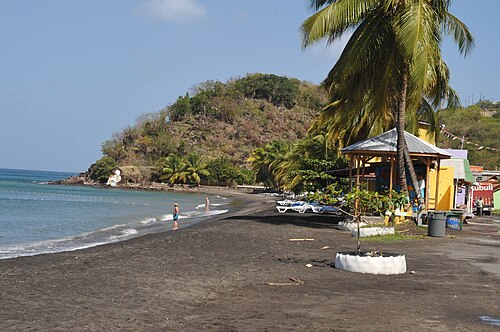
Mero Beach
Dominica’s easiest classic beach day: long gray-black sand, usually calm west-coast water, casual restaurants and a relaxed local atmosphere.
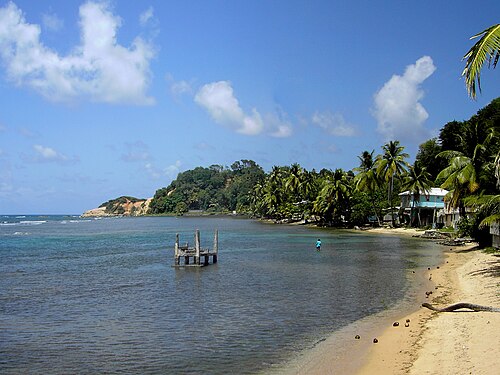
Batibou Beach
A cinematic palm-lined cove on the north coast reached by a steep access road. Confirm access and fees, and respect changing Atlantic conditions.
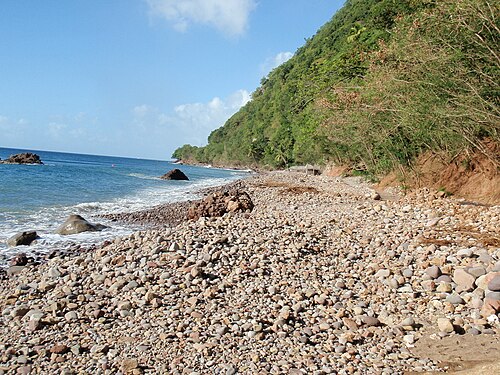
Champagne Beach
A pebbly shore prized less for lounging than for snorkeling over geothermal bubbles and reef life. Water shoes make the entry considerably less theatrical.
Purple Turtle Beach
A sandy, family-friendly Portsmouth beach with calm water, food nearby and views across Prince Rupert Bay.
Number One Beach
A wild black-sand cove reached on foot near Calibishie. It is beautiful, undeveloped and often too rough for casual swimming.
Pointe Baptiste & Red Rocks
Small coves beneath rust-colored formations on the northeast coast. Come for scenery and exploration; judge swimming conditions carefully.
Bubble Beach Spa
A tiny Soufrière shoreline where warm volcanic water meets the sea. It is more natural hot tub than traditional beach.
Scott’s Head
A narrow strip beside one of the Caribbean’s great marine reserves, with snorkeling and panoramic views from the headland.
Sargassum report
Reviewed July 26, 2026
CARICOOS reports an exceptionally large regional sargassum year in 2026. Dominica’s exposed Atlantic east and northeast beaches—including Rosalie, Woodford Hill and some Calibishie coves—face the greatest accumulation risk. Sheltered west-coast beaches such as Mero and Purple Turtle are usually less exposed. Conditions can change within days; ask your lodging for a current beach-specific report.
Popular tours
The Dominica experiences worth planning around.
Dominica rewards independence, but its strongest adventures depend on local knowledge of trails, rivers, sea conditions and communities. Schedule the biggest hike and the most weather-sensitive boat day early enough to recover from rain or rough water.
Boiling Lake & Valley of Desolation
Tackle the demanding eight-mile round trip with a certified local guide, sturdy footwear and a full day reserved for volcanic terrain, mud and rapidly changing weather.
Titou Gorge canyoning
Rappel, scramble and swim through rainforest ravines with a qualified operator that supplies technical equipment and cancels when upstream rainfall raises flash-flood risk.
Trafalgar Falls and hot springs
Pair the twin falls with Wotten Waven’s geothermal pools for a gentler adventure day that still feels unmistakably volcanic.
Indian River and Fort Shirley
Glide beneath the forest canopy with a licensed boat guide, then continue to Cabrits National Park for history and views over Prince Rupert Bay.
Kalinago Territory experience
Choose a community-led visit centered on local history, food, craft or hiking. Approach it as time with a living community, not a staged village stop.
Sperm-whale watching by boat
Search the deep west-coast water with a responsible operator that keeps its distance and explains the resident families. This is separate from a permitted in-water expedition.
The signature encounter
Swimming with Dominica’s sperm whales.
Female sperm whales and their calves live in Dominica’s deep coastal waters year-round. Entering the water with them is possible—but only through a scarce government research or tourism permit attached to an authorized expedition. It is not an add-on to an ordinary whale-watching cruise.
Book a dedicated week. Multiple days improve the odds and let the crew wait for calm, receptive animals.
Permit terms control group and vessel size. Follow the exact rules issued for your expedition.
No scuba is used. Expect deep ocean, repeated entries, swell and quick climbs back aboard.
Weather, whale behavior and permit rules decide every encounter. Ethical crews stop when whales avoid contact.
A good encounter
Small groups enter calmly with a licensed guide, remain together, avoid chasing and let the whale choose distance and duration. Calves, resting animals and social groups receive extra space.
Set realistic expectations
Some days produce breathtaking passes; others produce distant blows, dolphins or hours of blue water. Photography should follow the animal.
Sperm whale off Roseau · Michelle Reback / Wikimedia Commons · CC BY-SA 3.0
On & under the water
Volcanic topography continues below the surface.
Deep-sea fishing
Dominica’s volcanic coast falls into deep water almost immediately. A modest number of charters from Roseau, Portsmouth and the west coast work drop-offs and FADs for yellowfin tuna, mahi-mahi, wahoo, skipjack and occasional blue marlin or sailfish. Fishing is credible, but advance booking matters because the fleet is small.
Best timing: Tuna can be encountered through much of the year, with mahi, wahoo and billfish moving seasonally. Choose an operator that keeps a respectful distance from sperm whales and never treats cetaceans as fish-finding props.
Scuba diving
Dominica’s best-known sites cluster around the Soufrière–Scott’s Head Marine Reserve: Champagne, Scott’s Head Pinnacle, Dangleben’s, L’Abym, Crater’s Edge and Swiss Cheese. Farther north, Toucari, Cabrits and Salisbury add walls, reefs and less boat traffic. Expect volcanic pinnacles, bubbles, steep drop-offs, seahorses, frogfish, turtles, rays, squid and abundant smaller reef life.
Snorkeling
Champagne, Scott’s Head, Soufrière and Toucari offer the strongest accessible snorkeling when calm. Many entries are rocky, and reef drop-offs arrive quickly. Water shoes, a flotation aid for less-confident swimmers and local advice are more useful than pretending every cove is a swimming pool.
Sailing & anchoring
The west coast is the practical cruising side. Prince Rupert Bay has organized yacht services and moorings through PAYS; Roseau, Mero, Salisbury and the southwest offer additional stops in suitable conditions. The Atlantic coast is generally exposed. Use moorings inside marine reserves, confirm current clearance procedures in Portsmouth or Roseau and protect against strong katabatic gusts near mountain valleys.
Provision most completely in Roseau or Portsmouth. Astaphans, Whitchurch-area markets and local produce vendors cover basics, but specialty items and marine parts are limited—bring the obscure piece whose failure would ruin your week.
Surfing & paddling
The northeast and east coasts receive Atlantic swell around Calibishie and Marigot, but reef, current and limited rescue infrastructure favor experienced surfers with local guidance. Kayaking the Indian River, Prince Rupert Bay or the protected southwest is the more dependable paddle experience.
Culture, trails & excursions
Bring hiking shoes. Then bring their backup pair.
Culture
English is official, while Dominican Creole—Kwéyòl—reflects deep French and African influence. The Kalinago Territory is a living community, not an open-air exhibit; visit through community-led experiences. Carnival, the World Creole Music Festival and Independence season bring music, madras fabric, dance and Creole food into full color.
Hiking
The Boiling Lake trek is a demanding full day through Morne Trois Pitons, the Valley of Desolation and rapidly changing mountain weather; hire a qualified guide. The 14-segment Waitukubuli National Trail crosses the island. Middleham Falls, Emerald Pool, Syndicate Nature Trail, Freshwater Lake and Cabrits provide excellent shorter alternatives.
The annual calendar
Two seasons when Dominica's culture takes center stage.
Dominica's most rewarding celebrations feel inseparable from the island itself: Carnival brings masquerade and bouyon into the streets, while Creole and Independence season centers Kwéyòl language, traditional dress, food and music.
Usually February or early March · Roseau & island-wide
Mas Domnik: The Real Mas
J'Ouvert, calypso, bouyon, traditional masquerade and Carnival Monday and Tuesday create one of the Caribbean's most culturally rooted Carnival experiences.Late October–early November · Island-wide
Creole Day & Independence Celebrations
Jounen Kwéyòl, madras dress, Creole food and music lead into November 3 Independence Day and a season of national pride.Restaurants & hotels
The produce travels fewer miles than you did.
Keep an eye on current service at Palisades, Lacou, The Great Old House and waterfront hotel restaurants
Secret Bay’s Zing Zing, InterContinental dining, Keepin’ It Real and locally recommended beach cafés
Callaloo soup, provisions, plantain, breadfruit, fresh fish, crab backs, bakes and seasonal fruit
Fresh juice, cocoa tea, sorrel, bush rum and Kubuli beer—preferably after the cliff-edge hike
Hotel strategy
Eco-luxury is Dominica’s strength.
Secret Bay, Coulibri Ridge, Jungle Bay and Rosalie Bay turn nature into the main amenity. The InterContinental offers the island’s fullest conventional resort experience; Fort Young makes a practical Roseau base.
All-inclusive is not the point.
Meal plans can be useful at remote properties, but Dominica rewards guides, village restaurants and moving around. Confirm whether transfers, site passes, meals and excursions are included before comparing room rates.
Practical details
The useful things to know before you go.
English is official; Dominican Creole is widely used. French influence is visible in language, food and place names.
EC$2.70 equals US$1. U.S. dollars are widely accepted, but change often comes in EC dollars.
Cards work at major hotels and businesses. Carry EC cash for site fees, buses, small restaurants, guides and rural stops.
North American travelers need an adapter; single-voltage 120V appliances need a converter.
After heavy rain or a supply interruption, ask locally and use filtered or sealed water if clarity changes.
Roads are narrow, steep and winding. Visitors need a temporary local driving permit.
Transportation
Drive on the left. Visitors need a temporary local driving permit, often arranged by the rental company. Roads are narrow, steep and winding; a high-clearance vehicle helps on rough approaches. Minibuses are inexpensive but poor for a tightly scheduled hiking itinerary.
Safety
The U.S. advisory is Level 1 as of May 20, 2026. Petty theft occurs, but roads, flash floods, slippery trails, river crossings and powerful water are the larger practical risks. Never enter a gorge or remote trail when heavy rain threatens upstream.
Health & vaccines
Be current on routine vaccinations and review CDC advice, including hepatitis A and mosquito-borne illness precautions. Medical capability is limited; insurance with evacuation coverage is especially important for diving, canyoning and remote hiking.
Cost snapshot
Budget for site passes, guides and transfers. Boiling Lake, canyoning, diving and whale expeditions are specialized activities. A rental car can save money for two people, provided the driver is comfortable with genuinely mountainous roads.
Whale permits, ferry schedules, airline routes, trail access, river conditions, dive operations and restaurant hours change. Reconfirm every time-sensitive element directly before travel.
Research desk
Official sources & live checks
Use these for current permits, transport, trails, marine rules, safety and health guidance.