Find your bearings
Two volcanic islands. One short channel between them.
St. Kitts stretches from the rainforest north and historic west coast to a dry southeastern peninsula. Nevis rises more compactly across the Narrows. The crossing is quick, but each island deserves its own unhurried chapter.
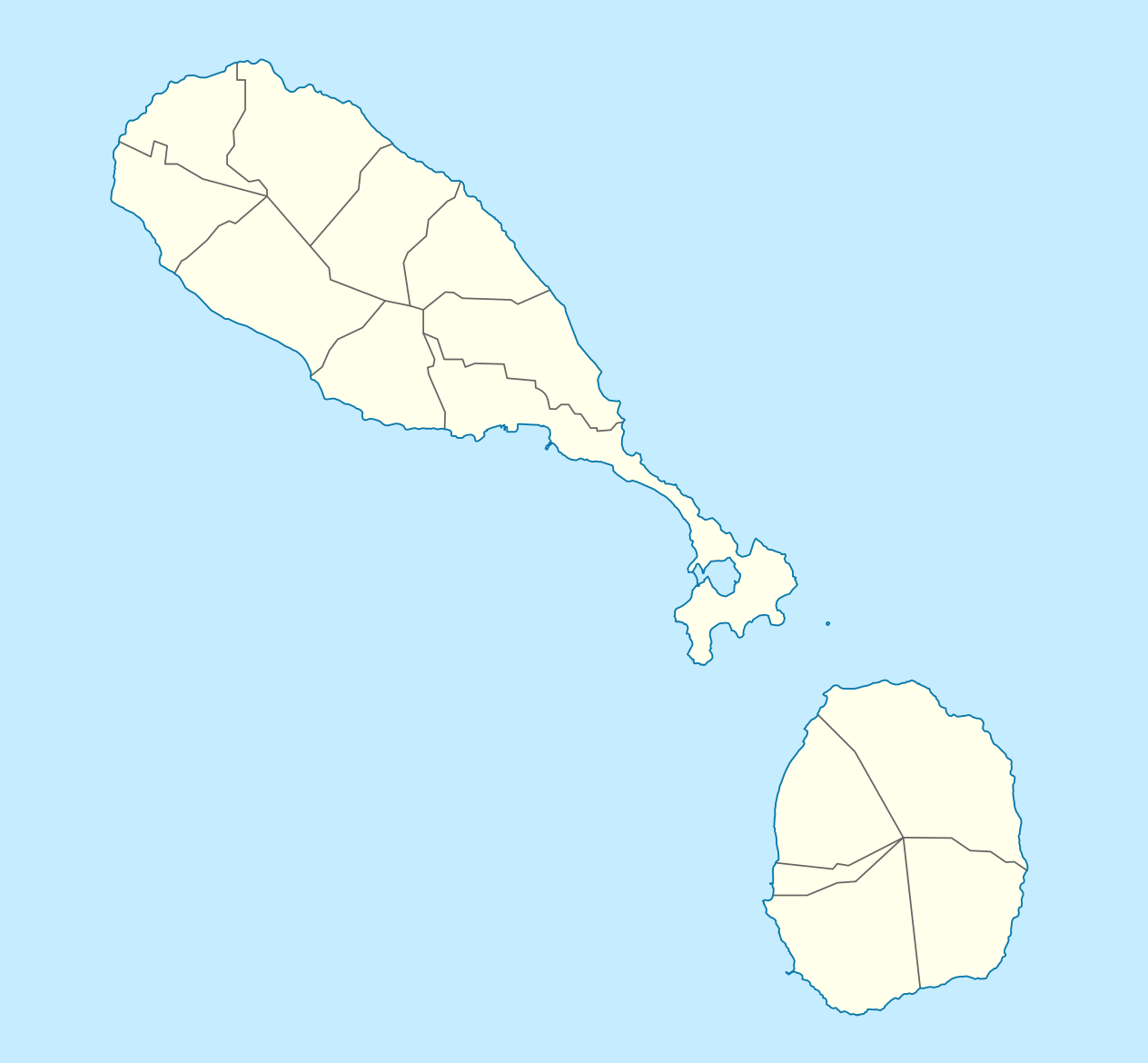 Caribbean SeaAtlantic Ocean
North & west St. Kitts
Rainforest, Brimstone Hill, sugar-estate history and quieter village roads.
Frigate Bay & the peninsula
The easiest base for restaurants, beaches, resorts and water taxis to Nevis.
Nevis
One compact island for mountain scenery, heritage hotels and sunset beaches.
Know the federation
Close enough to share a country. Different enough to deserve separate suitcases.
St. Kitts is the larger, busier island: cruise port, fortress, rainforest volcano, railway and a developed resort peninsula. Nevis is smaller, greener and more intimate, known for heritage inns, quiet beaches, hot springs and a mountain that seems to float beneath a cap of cloud. A ferry makes them easy to combine, but a day trip cannot replace sleeping on both.
A brief history
Kalinago communities knew St. Kitts as Liamuiga and Nevis as Oualie long before Europeans arrived. English and French settlement began in the 1600s, followed by violent dispossession of Indigenous people. Sugar wealth was built through the forced labor of enslaved Africans, whose descendants shaped the islands’ language, food, music and society. Brimstone Hill preserves both British military engineering and the labor of enslaved Africans who constructed it.
Nevis prospered early from sugar and became the birthplace of Alexander Hamilton. Its Bath Hotel, built in 1778 beside hot springs, pioneered Caribbean tourism. Slavery ended in the British colonies in the 1830s; the federation gained independence in 1983. The sugar industry on St. Kitts finally closed after the 2005 harvest, leaving rails, estates and villages that now anchor its tourism story.
What they are most known for
Brimstone Hill, the St. Kitts Scenic Railway, Mount Liamuiga, Timothy Hill, green vervet monkeys, Nevis Peak, Pinney’s Beach, elegant plantation-era inns, Alexander Hamilton, Bath hot springs, cricket, carnival, goat water and the short channel that connects two remarkably different vacations.
Geography
St. Kitts is an elongated volcanic island of roughly 65 square miles, crowned by 1,156-meter Mount Liamuiga and tapering into a dry southeastern peninsula. Nevis covers about 36 square miles and rises almost symmetrically to 985-meter Nevis Peak. The Narrows separates the islands by about two miles at its tightest point; Booby Island sits between them.
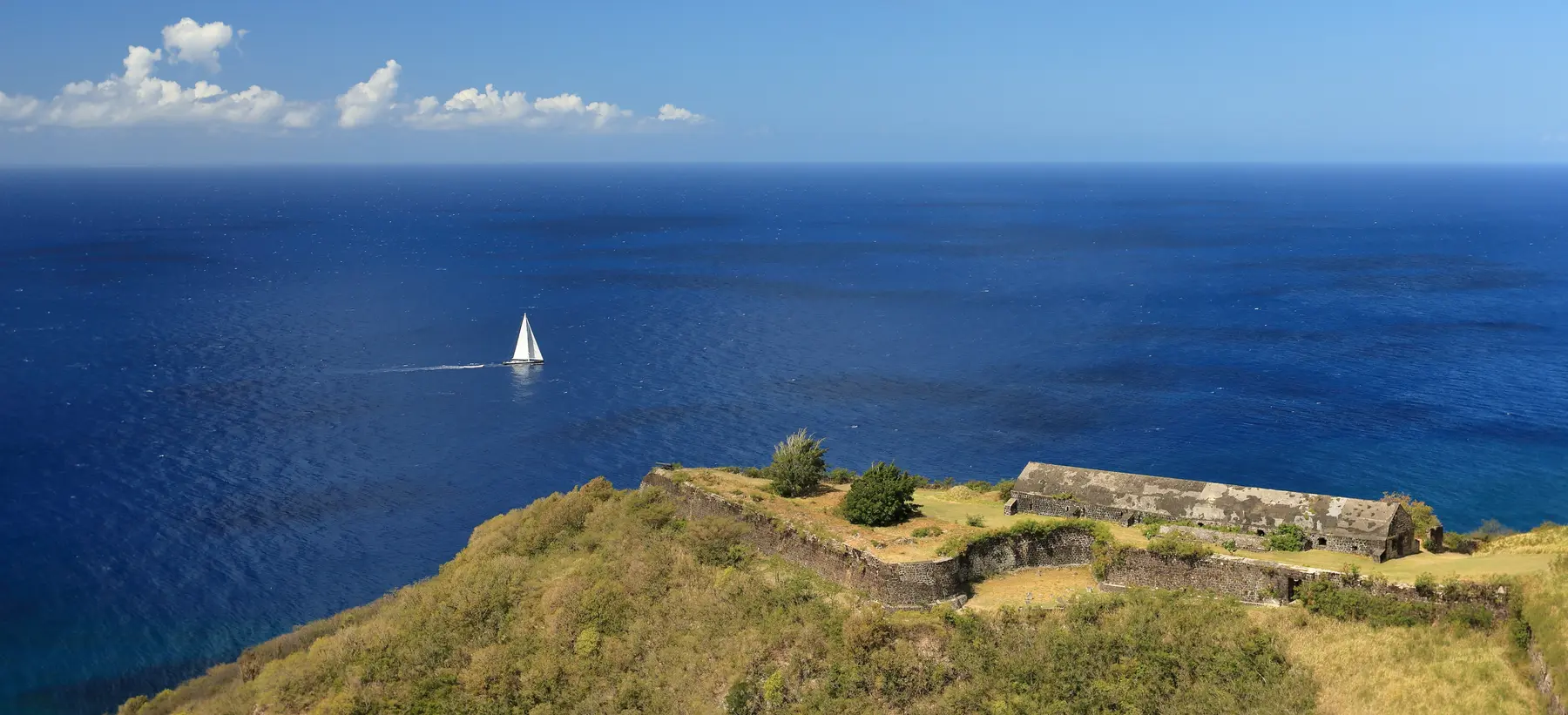
The citadel is both an extraordinary viewpoint and a place to confront the military and plantation history that shaped St. Kitts.
Martin Falbisoner · Wikimedia Commons · CC BY-SA 4.0Choose your rhythm
St. Kitts brings variety. Nevis brings stillness. The best trip uses both.
History, activities & easier logistics
Base here for Brimstone Hill, the scenic railway, Mount Liamuiga, a wider restaurant range, nightlife around Frigate Bay and direct access to the international airport. It suits first-time visitors who want full days and more conventional resort infrastructure.
Romance, quiet & heritage hotels
Nevis rewards slow mornings, sunset beach walks, gardens, historic inns and personal service. It is the more distinctive choice for couples and travelers who find a silent hillside pool more appealing than a packed excursion schedule.
Four nights St. Kitts + three on Nevis
Start with sightseeing and the harder activities on St. Kitts, then ferry to Nevis and let the trip exhale. Reverse the order only when international flight timing makes the final transfer risky.
Give Nevis a focused visit
From St. Kitts, a taxi-and-water-taxi day can cover Charlestown, Bath Spring, a heritage stop and Pinney’s Beach. An overnight stay reveals the island’s quieter evening rhythm.
Plan your trip
Winter and early spring offer the cleanest balance of trails, beaches and lower humidity.
December–April
Drier weather, cooler hiking mornings and the broadest flight schedule. Christmas, carnival weeks and February–March can command premium hotel rates.
May–June
Warm water, greener hills, fewer crowds and good value before peak storm season. Expect more humidity and brief heavy showers.
August–November
The wettest, hottest stretch overlaps peak Atlantic hurricane risk. Some inns, restaurants and tours reduce hours or close seasonally.
Are St. Kitts and Nevis hurricane-safe?
No. Hurricane season officially runs June through November. The islands sit within the main Atlantic storm belt and can experience flight, ferry, power and hotel disruption even without a direct landfall. Use flexible reservations, proper insurance and a plan that does not require the final ferry to operate before your flight home.
How to get there
Fly into St. Kitts, then cross to Nevis by ferry or water taxi.
Robert L. Bradshaw Airport · SKB
St. Kitts receives nonstop service from several North American and UK gateways, much of it seasonal, plus regional Caribbean flights. SKB is close to Basseterre and Frigate Bay. Check the live airline schedule.
Basseterre ↔ Charlestown
Public passenger ferries generally take 25–45 minutes and operate multiple times on most days. Schedules differ by weekday, vessel and season; verify the same day and arrive early enough to buy a ticket and load luggage.
Reggae Beach ↔ Oualie
Scheduled and private water taxis cross the Narrows in roughly 10–15 minutes. This is usually the cleanest route between the St. Kitts airport or peninsula resorts and a Nevis hotel, once the road transfer to the pier is included.
Major’s Bay ↔ Cades/Long Point
Car ferries connect the islands, but a rental car may require written permission and may not be covered off its home island. Never drive onto the ferry until the rental company confirms the contract and insurance.
Where to stay
Choose the island first. Then choose beach convenience or hillside character.
A well-chosen base keeps dinner rides short. Splitting hotels is worth the repacking: the two islands feel most different early in the morning and after the day-trippers leave.
Best overall on St. Kitts · restaurants, beach & convenience
Frigate Bay · St. Kitts
The easiest all-purpose base sits between the livelier Caribbean beach and the breezier Atlantic side. Restaurants, the Strip, supermarkets and several hotels are close, while Basseterre and the airport remain a short drive away.
- Nearby
- South Frigate Bay, the Strip, Timothy Hill, Basseterre
- Consider
- St. Kitts Marriott, Royal St. Kitts Hotel, Timothy Beach Resort
Best for resort luxury, calm beaches & views of Nevis
Southeast Peninsula · St. Kitts
A dramatic road crosses salt ponds and dry hills to Cockleshell, Banana and Major’s bays. The setting is the island’s most cinematic and the water taxi to Nevis is close, but dining and groceries are spread out and taxis can become expensive.
- Nearby
- Cockleshell Bay, Park Hyatt, water taxis, the Narrows
- Consider
- Park Hyatt St. Kitts, Sunset Reef, villas around Christophe Harbour
Best for rainforest, history & escaping the resort belt
North & west St. Kitts
The greener half of St. Kitts places Brimstone Hill, Romney Manor and Mount Liamuiga within easier reach. It is quiet after dark and far from the southeast beaches, but the landscape and local character are considerably stronger.
- Nearby
- Brimstone Hill, Wingfield Estate, Liamuiga, Dieppe Bay
- Consider
- Belle Mont Sanctuary Resort, villas and village guesthouses
Best on Nevis for beachfront luxury & sunset
Pinney’s Beach · Nevis
Nevis’s longest, most recognizable beach runs north from Charlestown beneath the mountain. It combines resort polish with independent beach bars and makes the easiest choice for travelers who want sand without giving up convenient access.
- Nearby
- Pinney’s Beach, Charlestown, golf, Sunshine’s and beach bars
- Consider
- Four Seasons Nevis, Hamilton Beach Villas, nearby villas
Best for calm water, families & quick St. Kitts transfers
Oualie & Cades Bay · Nevis
The northwest coast has gentle swimming, water sports and the shortest water-taxi connection to St. Kitts. Oualie feels friendly; Cades Bay is practical for ferries and villas. A car or taxis are useful for dinner variety.
- Nearby
- Oualie Beach, water-taxi pier, Cades Bay, Lovers Beach
- Consider
- Oualie Beach Resort, Mount Nevis Hotel, villas and apartments
Best for romance, heritage inns & rainforest atmosphere
Nevis Peak foothills
Gingerland and the elevated southern slopes trade immediate beach access for gardens, cool breezes and historic estate character. This is Nevis at its most distinctive—quiet, green and excellent for couples who do not need to walk to the sea.
- Nearby
- Golden Rock, Montpelier, Hermitage, Peak hikes, historic estates
- Consider
- Golden Rock Inn, Montpelier Nevis, The Hermitage
Beaches worth choosing deliberately
Caribbean coasts for swimming. Atlantic coasts for drama.
The sand is naturally pale gold, dark volcanic gray or something in between; do not expect Anguilla’s endless white powder. St. Kitts offers more variety and beach infrastructure. Nevis offers longer, quieter walks and a stronger sense of escape.
Cockleshell Bay · St. Kitts
A long, social Caribbean-side beach facing Nevis, with pale-gold sand, calm water, restaurants and water taxis. Cruise days can be lively; mornings and late afternoons feel softer.
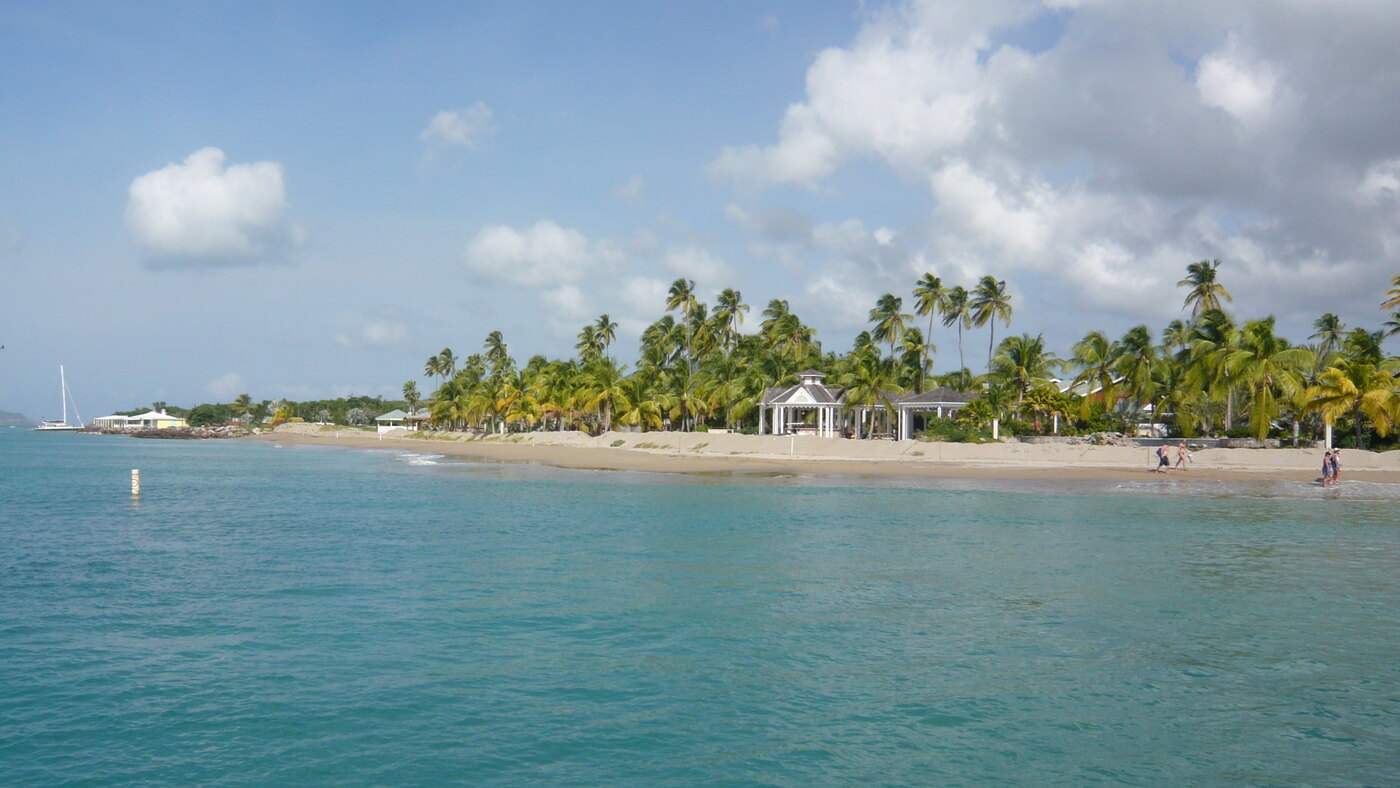
Pinney’s Beach · Nevis
Nevis’s signature beach: a long golden-sand sweep backed by palms, the Four Seasons and independent beach bars. It is especially beautiful at sunset and varies from manicured resort frontage to wonderfully empty stretches.
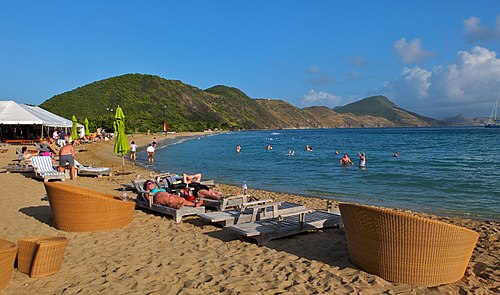
South Friars Bay · St. Kitts
A compact west-facing bay with clear swimming, beach restaurants and useful snorkeling near the rocky ends. Carambola is upscale; Shipwreck has a more relaxed local-beach-bar mood.
South Frigate Bay · St. Kitts
The island’s most convenient beach for food, drinks and an easy sunset. Choose it for atmosphere and walkability.
Oualie Beach · Nevis
Warm, shallow, family-friendly water with a small hotel, restaurant, water sports and a pier. Boats share the bay, so swim within the marked and locally recommended area.
Major’s Bay · St. Kitts
A quieter southeastern strand with generally gentle Caribbean water. The car-ferry pier uses one end, so settle well away from vessel operations.
Dieppe Bay · St. Kitts
Dark volcanic sand and a reef-sheltered bay meet on the island’s north coast. It is atmospheric and historically interesting, though not the classic turquoise-white-sand fantasy.
Lovers Beach · Nevis
A quiet, undeveloped strip near the north end of the island. There are no reliable facilities or lifeguards; bring what you need and check sea conditions.
Sheltered Caribbean coasts are the better fallback
Reviewed July 29, 2026
NOAA’s current regional monitoring follows another very large Caribbean sargassum season. Accumulation changes quickly with wind, current and cleanup. The Atlantic-facing shores—North Frigate, Half Moon, Conaree and exposed eastern or southeastern coves—usually carry the higher risk. Sheltered Caribbean beaches such as South Friars, Cockleshell, Pinney’s and Oualie are generally better bets, not guarantees.
Ask the hotel for a same-day photo before committing to a beach transfer. Ten minutes of local information can outperform ten pages of last month’s reviews.
The experiences that define the destination
St. Kitts and Nevis’s most worthwhile tours.
Cruise traffic produces many quick panoramic outings on St. Kitts. Overnight visitors should go earlier, stay later and choose guides who can discuss Indigenous, African and colonial history.
Brimstone Hill + Romney Manor
Pair the UNESCO fortress with Wingfield Estate and Caribelle Batik for the strongest introduction to St. Kitts’s colonial, sugar and landscape history.
St. Kitts Scenic Railway
Ride the surviving sugar-cane railway around the north and east coast, completing the island loop by bus. Operations often follow cruise demand, so confirm the date before building a day around it.
Mount Liamuiga guided hike
Climb through rainforest to the crater rim with an experienced guide, sturdy shoes and a conservative weather call. This is a real mountain outing, not a signed urban trail.
Full-day catamaran to Nevis
Sail the Narrows, snorkel and land near Pinney’s Beach. It is celebratory and easy, though it shows far less of Nevis than an overnight stay.
Nevis heritage island tour
Link Charlestown, the Hamilton museum, Bath hot springs, churches, sugar-estate ruins and mountain viewpoints with a guide who can turn scattered sites into one story.
Nevis Peak rainforest hike
Use a specialist guide for the steep, muddy route and its fixed ropes. A lower rainforest or waterfall walk is the smarter choice for many otherwise active travelers.
Two-island food day
Taste saltfish, goat water, johnnycakes, fresh seafood and Nevis mango products, balancing roadside kitchens with one of the islands’ celebrated estate restaurants.
Reef-and-wreck dive day
Dive a sheltered wreck such as River Taw or MV Talata, then add Monkey Shoals, Brimstone Shallows or a southern reef according to conditions and experience.
Timothy Hill + peninsula beaches
Stop where the Atlantic and Caribbean frame the narrow peninsula, then continue to South Friars, Cockleshell or Major’s Bay.
Nevis hot springs
Soak at the public Bath Spring beside the historic Bath Hotel. Water can be extremely hot; enter gradually, keep valuables close and pair the stop with Charlestown.
On & under the water
Underrated wreck diving, easy inter-island sailing and highly conditional surf.
Deep-sea fishing
St. Kitts and Nevis support a modest but established charter scene from Basseterre, the southeast peninsula and Oualie Bay. Offshore trolling targets wahoo, mahi-mahi, tuna, barracuda, kingfish and occasional marlin or sailfish in the channels and deeper Atlantic water.
Best timing: Wahoo is generally strongest in winter, mahi often improves from late winter into spring and billfish are possible in warmer periods. Ask whether pickup between the two islands is included or requires a separate water taxi.
Scuba diving
Most dive operations depart from St. Kitts and work the sheltered southwest coast, the Narrows and sites between the islands. River Taw is a shallow freighter wreck transformed into reef habitat; MV Talata and Corinthian add wreck variety. Monkey Shoals offers coral heads in the channel, while Brimstone Shallows, Sandy Point, Coconut Tree Rocks and Friars Bay provide reefs, slopes and deeper profiles.
Expect turtles, southern stingrays, garden eels, morays, lobster, schools of jacks and barracuda, with reef sharks possible at offshore sites. Visibility and current vary. Nevis has fewer operators and departure options, so serious divers should confirm pickup and minimum numbers before choosing a Nevis-only stay.
Reef health
The destination still has strong coral, sponge and fish life, especially away from heavily used bays, but it shares the Caribbean’s pressures from marine heat, bleaching, disease, storms, runoff and anchor damage. “Untouched” is marketing, not a scientific condition. Choose a mooring-conscious operator and ask what it observed this week.
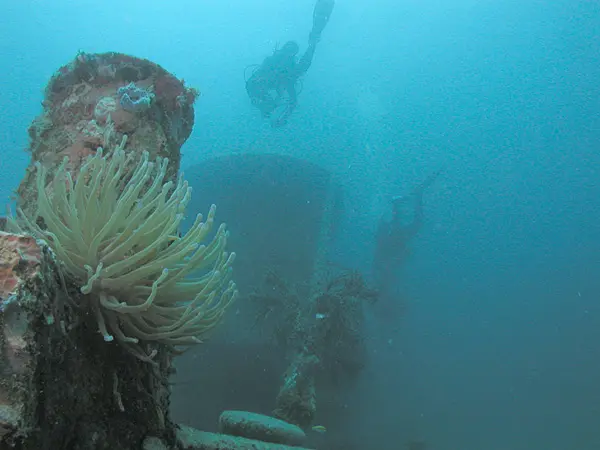
The shallow River Taw wreck is one of the federation’s signature dives, pairing accessible depth with coral growth, fish life and the unmistakable geometry of a ship underwater.
Clark Anderson · Wikimedia Commons · CC BY-SA 2.5Snorkeling
South Friars Bay and White House Bay are the most useful shore-snorkel options on St. Kitts when calm. Shitten Bay, Monkey Shoals and reef sites in the Narrows are stronger by boat. On Nevis, Oualie and rocky sections near Pinney’s can hold fish, but broad sandy areas are not coral gardens. Boat snorkeling gives better visibility, habitat and safety than swimming far offshore alone.
Sailing
The Narrows makes an easy scenic sail, while the southwest coast of St. Kitts offers anchorages near Frigate Bay, South Friars, White House Bay, Ballast Bay, Major’s Bay and Cockleshell. Nevis’s west coast has moorings and access near Charlestown, Pinney’s and Oualie. Swell can make otherwise convenient bays surprisingly rolly.
International arrivals must clear at an authorized port before exploring. Port Zante/Basseterre is the primary St. Kitts option; Charlestown and Long Point serve Nevis, with some marina assistance available elsewhere. Complete current pre-arrival forms, keep clear of ferry and cruise approaches and never anchor on coral. Major provisioning is easiest on St. Kitts; top up there before a quiet Nevis stay.
Surfing
St. Kitts can produce rideable waves at Sandy Bank Bay, North Friars, North Frigate/Marriott Reef and Conaree when the swell and wind line up. Sandy Bank is the usual lesson location; reef breaks require local knowledge. Nevis has occasional surf, but limited rentals and no reason to choose it over a dedicated Caribbean surf destination. Treat surfing as a weather bonus, not the foundation of the trip.
Culture & trails
The deepest stories live in the estates, villages, kitchens and rainforest.
Culture
Kittitian and Nevisian culture grows from African-Caribbean traditions, British colonial history and the distinct pride of each island. Cricket matters. So do calypso, soca, masquerade, moko jumbies, steelpan, church, family and political life. St. Kitts’s Sugar Mas runs through the Christmas season; Nevis Culturama fills late July and early August.
Food is the easiest doorway: goat water, stewed saltfish, coconut dumplings, johnnycakes, conch, lobster, rice and peas, plantain, local fruit and Nevis’s formidable mango season. Vervet monkeys are culturally iconic but invasive; never feed them or leave food accessible.
Historic essentials
On St. Kitts, prioritize Brimstone Hill, Romney Manor/Wingfield Estate and a thoughtful Basseterre walk. On Nevis, combine the Museum of Nevis History, Bath Hotel and Spring House, Cottle Church, New River Estate and at least one restored historic inn. The sites are beautiful, but their plantation landscapes must be understood through slavery as well as architecture.
Mount Liamuiga
The standard guided route climbs through humid rainforest to the crater rim in roughly four to six hours. Mud, roots, steep sections, cloud and route-finding make it strenuous. A solo hiker died after becoming lost on the mountain in May 2026. Go with a reputable guide, start early, carry substantial water and cancel when weather or fitness argues against the climb.
Nevis Peak
Nevis Peak is shorter in mileage and often harder in movement: very steep mud, roots and fixed ropes on the upper route. A guide is strongly recommended, and summit cloud frequently erases the view. The rainforest experience is the reward.
Gentler alternatives
Walk the rainforest around Wingfield and the lower Liamuiga slopes, explore the Bat Cave/River trail with a guide, follow the Nevis Heritage Trail, stroll Golden Rock’s gardens or arrange a lower-elevation waterfall and village walk. These deliver ecology and history without turning vacation into a rescue exercise.
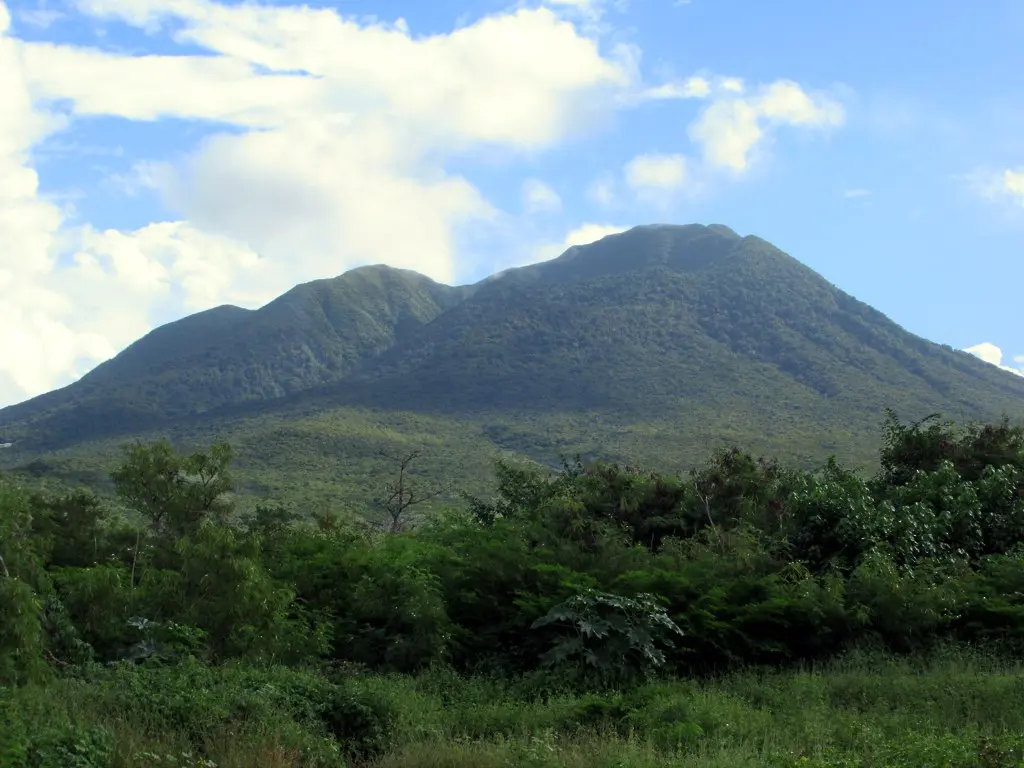
Nevis Peak is the island’s constant backdrop—lush, often cloud-crowned and best explored with a guide who understands the steep upper route.
David Stanley · Wikimedia Commons · CC BY 2.0The annual calendar
Swim the Narrows in spring. Follow the music into summer.
The federation's two selected events could hardly be more different: one crosses the channel between the islands under human power, while the other fills St. Kitts with international and Caribbean sound.
Usually late March · Nevis to St. Kitts
Nevis–St. Kitts Cross-Channel Swim
Swimmers tackle approximately 2.5 miles of open water between Oualie Beach and Cockleshell Bay, with visitors welcome to race or watch the finish.Usually late June · St. Kitts
St. Kitts Music Festival
Several nights of international and Caribbean reggae, soca, R&B, dancehall and other genres create one of the federation's largest visitor events.Restaurants & hotels
St. Kitts has more choice. Nevis has more places worth dressing for.
Hours and closing days change seasonally, especially on Nevis. Reserve estate restaurants and weekend dinners, then leave space for roadside barbecue, a bakery breakfast and whatever fish came in that morning.
Marshall’s, Spice Mill, Carambola, Fisherman’s Village at Park Hyatt and resort restaurants around Christophe Harbour
Reggae Beach Bar, Shipwreck, the Frigate Bay Strip, local kitchens in Basseterre and village barbecue stands
The Rocks at Golden Rock, Montpelier’s Mill Privée and Terrace, Hermitage, Mango and EsQuilina at Four Seasons
Sunshine’s, Lime Beach Bar, Oualie Beach Restaurant, Bananas, Indian Summer and small Charlestown lunch spots
Hotel strategy
Do not book the same vacation twice.
Best luxury split
Pair Park Hyatt or the full-buyout Sunset Reef on St. Kitts with Four Seasons, Montpelier or Golden Rock on Nevis. Choose contrasting settings—beach first, mountain second.
Best character
Belle Mont on St. Kitts and Hermitage or Golden Rock on Nevis preserve the islands’ garden, estate and cottage atmosphere. Confirm seasonal operations and use a rental car for freedom.
Best value
Royal St. Kitts and Timothy Beach provide practical St. Kitts bases. On Nevis, look at Oualie, Hamilton Beach Villas, Mount Nevis Hotel and locally managed apartments.
Practical details
Easygoing once you respect left-side driving, ferry clocks and the mountain weather.
English is official and universal. Local speech carries its own rhythm, vocabulary and island variation.
EC$ is fixed at EC$2.70 to US$1. U.S. dollars are widely accepted; change may come in EC$.
Major cards work at established businesses. Keep EC$ or small U.S. notes for ferries, buses, beach bars, taxis and tips.
Type D/G are common, while some hotels provide A/B or 110V outlets. Confirm the room and use dual-voltage devices.
Municipal and hotel water is generally treated. Drought restrictions and property cisterns occur.
Visitors need a temporary local permit. Roads can be narrow, dark and unevenly signed.
Cash & cards
Hotels, established restaurants and rental agencies accept major cards. Keep EC$ or small U.S. notes for ferries, buses, beach bars, taxis and tips. ATMs are available in Basseterre, Frigate Bay and Charlestown, but should not be your only cash plan.
Transportation
Traffic drives on the left. Taxis are plentiful, and minibus routes are inexpensive but designed for residents. Rental cars suit independent explorers; visitors need a temporary local driving permit, normally arranged by the rental company. Roads are narrow, signed unevenly and dark after sunset. Confirm separately whether a car may cross between islands.
Safety
The current U.S. advisory is Level 1, but normal precautions still matter: use registered taxis, avoid isolated beaches after dark, secure valuables and do not display cash. Beaches commonly lack lifeguards. The greatest adventure risks are heat, rough water, road edges and underestimating the volcano trails.
Health & vaccines
Be current on routine vaccines and review CDC guidance. Mosquito protection matters for dengue and other mosquito-borne disease. Yellow-fever proof can be required when arriving from a risk country. Hospitals provide basic care on both islands, but serious illness, trauma or diving injury may require regional evacuation; insurance should cover it.
Research desk
Official sources & live checks
Ferry times, seasonal flights, attraction operations and trail conditions can all change. These are the best starting points for live confirmation.